The modern hardware market is increasingly pivoting toward optimizing the total cost of ownership without compromising on high-end performance. AMD is addressing this demand by strategically filling gaps within its budget-tier portfolios. The introduction of the Ryzen 5 7500 and 5500F is designed to broaden accessibility, catering both to users of legacy platforms and those transitioning to current industry standards. The recently unveiled pricing underscores the company's ambition to solidify its dominance in the entry-level segment.
AMD's current consumer strategy resembles a sophisticated balancing act. On one hand, the company continues to support the AM4 platform, which has become an industry anomaly in terms of longevity. On the other, it is aggressively lowering the barrier to entry for the AM5 ecosystem, ensuring that the transition to DDR5 and a new socket is no longer financially taxing for the average user.
The Ryzen 5 7500 has emerged as the cornerstone for modernizing system fleets. Essentially a full-fledged representative of the Zen 4 family, it differs from its sibling, the 7500F, by the inclusion of integrated graphics. While the RDNA 2 block—with its limited compute units clocked up to 2.2 GHz—isn't designed for demanding gaming, it provides essential system viability, which is critical for office builds or the initial configuration phase of a PC.
The processor's technical profile is impressively well-rounded: six cores and 12 threads with a base clock of 3.7 GHz and a boost potential of up to 5.0 GHz. Meanwhile, power consumption remains modest at 65W, and a 38MB cache allows it to handle modern workloads efficiently. A recommended price of $189 makes this chip exceptionally attractive, especially compared to earlier forecasts that placed the bar at $230. However, the European market exhibits its typical lag, with pricing hovering around 228 euros.
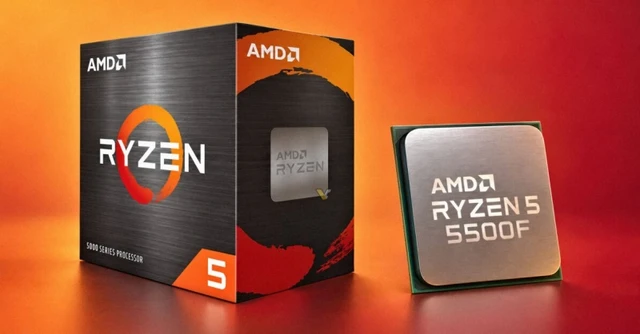
Simultaneously, AMD is giving its legacy hardware a new lease on life with the release of the Ryzen 5 5500F. This processor targets ultra-budget configurations based on Zen 3. Here, we see a tried-and-true formula: six cores, 12 threads, and clock speeds ranging from a 3.0 GHz base to 4.4 GHz in boost mode. Despite a more modest L3 cache (16MB) compared to contemporary models, PCIe 4.0 support enables the use of high-speed NVMe drives, mitigating many of the limitations inherent to the budget segment.
The value proposition of the 5500F is particularly striking. At $99, this processor becomes the perfect bedrock for a budget gaming PC, where the primary financial weight is shifted toward the graphics card. In Europe, the price remains around 100–110 euros, making it virtually equivalent to the US market even after accounting for tax premiums.
In essence, AMD is constructing a tiered upgrade path. Users can either breathe new life into an old AM4 system at a minimal cost or make a moderately priced leap into the AM5 era, gaining access to modern memory and interface standards. It is a strategic maneuver that allows the company to maintain brand loyalty across diverse economic demographics.
 Apple’s Strategic Foray into the Gaming Controller Market