The modern GPU market is transitioning into the Blackwell era, an epoch where computational efficiency and aesthetic appeal have become equal priorities. In this high-stakes race, GIGABYTE unveils the AORUS INFINITY edition of the GeForce RTX 5070, seeking to redefine the conventional identity of the mid-range segment. The device pairs an aggressive factory overclock with a cooling system of almost futuristic design. It is a calculated effort to craft a premium experience in a space typically dominated by sterile pragmatism.
The emergence of new iterations in the GeForce RTX 5000 lineup suggests that NVIDIA's partners still found room for innovation even after the official launch. The AORUS INFINITY distinguishes itself from standard offerings not just through its aesthetics, but through its performance ambitions. At its core lies the GB205 GPU, fabricated using the TSMC 4NP process. GIGABYTE's engineers took a bold step, pushing the boost clock from the reference 2,512 MHz to 2,715 MHz, positioning this card as one of the fastest in its class straight out of the box.
This technical foundation is augmented by cutting-edge GDDR7 memory with a bandwidth of 28 Gbps per pin. Despite the aggressive factory overclock, power consumption remains within the reference 250W envelope, presenting the cooling system with the significant challenge of dissipating heat without excessively increasing noise levels.
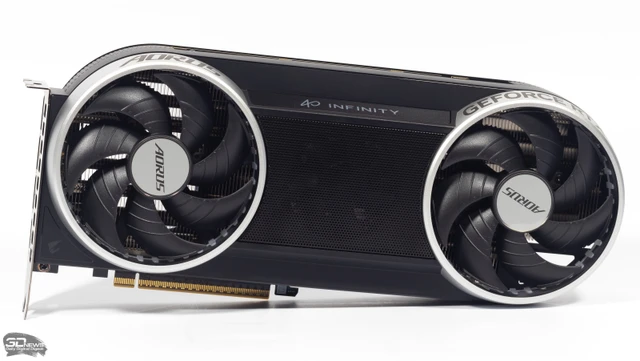
The visual concept of the AORUS INFINITY strongly evokes aviation turbines. A shroud with soft, rounded edges conceals three fans: two primary 95mm units and one auxiliary fan positioned behind a central mesh. This configuration ensures efficient through-flow cooling, as the primary components are concentrated in the center of the PCB, while the video output interfaces are relegated to a separate "island." This architectural approach mirrors the design of top-tier Founders Edition models, although here the connection between modules is handled via PCB bridges.
The power delivery ergonomics deserve particular mention. The 12V-2x6 connector is oriented parallel to the motherboard, eliminating dangerous cable bends—a critical consideration for modern high-wattage GPUs. The aesthetic is rounded out by a dedicated decorative cover that hides the connection and an adjustable support bracket, essential for stabilizing the massive three-slot chassis measuring 309mm in length.
In real-world gaming scenarios, the card demonstrates impressive dynamics. In 1080p rasterization, it comfortably dominates previous-tier solutions like the RTX 5060 Ti or Radeon RX 9060 XT, outperforming them by 35–41%. However, when stepping up to 1440p, the model's primary compromise becomes apparent: the 12GB VRAM capacity. In several modern titles, this volume becomes a bottleneck, slowing the rate of performance growth compared to better-equipped competitors, such as the RTX 5070 Ti.
The ray tracing performance further highlights the technological divide. Without upscaling algorithms, the card struggles to maintain a comfortable frame rate in demanding scenes. However, activating DLSS in Balanced mode, combined with Frame Generation and Ray Reconstruction, completely transforms the experience. NVIDIA's suite of technologies effectively mitigates the VRAM deficit and ensures fluid visuals even in the most taxing titles, turning the device into a fully capable high-resolution gaming tool.
The device's thermal behavior evokes mixed emotions. On one hand, GPU and memory temperatures do not exceed 69°C even under sustained loads, testifying to the radiator's high efficiency. On the other hand, this thermal headroom comes at the cost of acoustic comfort: noise levels reach 41 dBA, and the absence of a "silent" BIOS profile makes the card quite audible.
For enthusiasts, there is significant potential for manual overclocking. Increasing the power limit by 20% allows for a GPU clock boost of approximately 300–350 MHz and pushes memory bandwidth up to 34 Gbps. This yields a tangible performance uplift—averaging around 8%—though it raises power consumption to 283W and increases noise to 43 dBA.
In terms of market positioning, the AORUS INFINITY occupies the "premium mid-range" niche. It commands a significant premium over base RTX 5070 versions and competing AMD solutions, yet remains more accessible than the RTX 5070 Ti. It is a conscious choice for those prioritizing aesthetics and factory overclocking, transforming a standard accelerator into a striking centerpiece of a build, capable of handling most modern tasks provided NVIDIA's full arsenal of software optimizations is utilized.
 The High-NA EUV Technological Leap