The realm of professional esports demands absolute precision and instantaneous reflexes, where a mere handful of milliseconds can dictate the outcome of a match. For years, the 24.5-inch form factor has served as the gold standard for FPS players, striking the perfect balance between peripheral awareness and focused concentration. Samsung Display is now redefining this benchmark by integrating QD-OLED technology into the industry's most coveted panel size. This move signals a transition into an era where uncompromising visual fidelity no longer comes at the expense of speed.
In the realm of competitive gaming, ergonomics are not merely a preference—they are a critical performance factor. The compact 24.5-inch form factor allows gamers to encompass the entire field of view in a single glance, eliminating the need for head movement and minimizing reaction times. This is precisely why Samsung Display has pivoted toward the mass production of Full HD panels in this specific size, engineering a tool meticulously tailored for the demands of esports and high-octane first-person shooters.
The technological edge of these new panels stems from the synergy between organic light-emitting diodes and quantum dots (QD-OLED). Unlike traditional solutions, this architecture delivers a near-instantaneous response time of just 0.3ms, effectively eradicating motion blur and ghosting. The integration of quantum dots ensures exceptional color purity and saturation while maintaining the deep, true blacks that are only possible through per-pixel luminance control.
Samsung Display’s dominance in this segment is reflected in the data. According to analysis from Omdia, the company now controls nearly 75% of the QD-OLED market, having shipped approximately 2.5 million panels last year. The rollout of 24.5-inch modules is more than a mere portfolio expansion; it is a strategic capture of the professional gaming niche, where hardware requirements traditionally far exceed those of the general consumer sector.
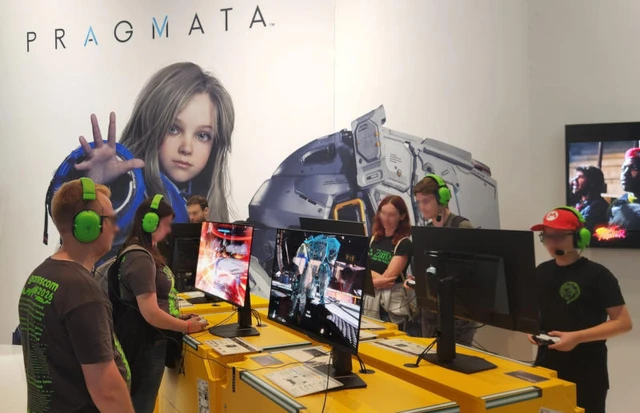
At Gamescom 2026 in Cologne, it became evident that the industry's heavyweights are fully backing this technology. Strategic partnerships with Capcom, Krafton, and CD Projekt Red showcase the practical application of these panels in the most demanding scenarios. From the fluid, high-speed combat of Street Fighter 6 to the immersive visual depth of The Witcher 3 expansions, QD-OLED is emerging as the new gold standard for content visualization.
Of particular interest is the introduction of QD-OLED Penta Tandem technology. A five-layer stack of light-emitting layers significantly boosts peak brightness and extends the panel's operational lifespan, addressing one of OLED's primary vulnerabilities: burn-in caused by static UI elements—a critical concern for gaming monitors.
Integrating such innovations into the standard esports form factor means that professional players and enthusiasts are gaining access to tomorrow's technology today. Samsung Display is effectively forging a new ecosystem where the monitor's hardware ceases to be a bottleneck and instead becomes a genuine competitive advantage.
 Nvidia’s Technological Pragmatism in the Open-Model Race