The entry-level GPU market has traditionally been a realm of compromise, where raw performance is often bottlenecked by modest cooling solutions. However, the arrival of new Radeon RX 9050 variants is disrupting this paradigm, providing users with substantial thermal headroom and factory-tuned clock speeds. This commitment to unwavering stability transforms what was once a budget-tier offering into a robust gaming instrument. At the heart of this shift is Gigabyte’s strategic approach to expanding the device's thermal envelope.
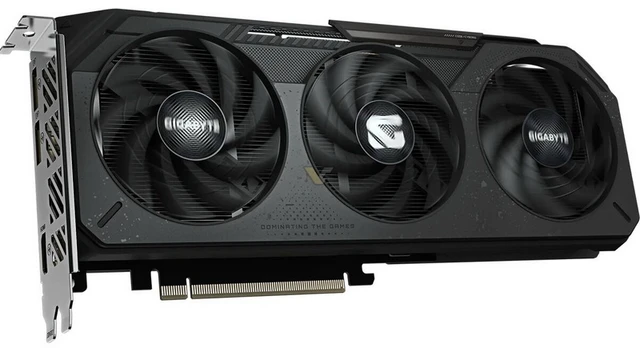
Within the entry-level GPU landscape, the Radeon RX 9050 serves as a foundational building block; however, the Gaming OC edition challenges traditional perceptions of what "entry-level" should entail. While most manufacturers opt for a standard dual-fan setup, this model implements a full triple-fan array. This approach does more than just maintain stable temperatures—it significantly lowers the system's acoustic profile, as each individual fan can operate at lower RPMs while maintaining peak efficiency.
Particular attention has been paid to the WindForce system, which integrates a zero-RPM mode for low-load scenarios. This transforms the graphics card into a completely silent device during productivity tasks or media consumption. The heatsink's physical footprint extends well beyond the dimensions of the PCB, creating a massive thermal buffer, while the third fan ensures optimal airflow to effectively dissipate heat from all system components. The design is rounded out by a reinforced backplate, which not only prevents PCB sagging but also facilitates more uniform heat distribution across the surface.
On a technical level, the Gaming OC demonstrates a significant departure from AMD's reference specifications. While the standard gaming clock sits at 1920 MHz with a boost up to 2600 MHz, this version pushes those figures to 2260 MHz and 2760 MHz, respectively. An 18% increase in base frequency and a 6% bump in boost clocks ensure more consistent frame rates in demanding scenes where standard cards might otherwise trigger thermal throttling.
Market analysis reveals that the Radeon RX 9050 segment has become a battleground for every single megahertz. The Sapphire Pulse offers similar clock speeds, while the Asus Dual can peak at 2770 MHz—albeit only within a software-driven OC profile. The advantage of the Gaming OC version lies in the fact that these elevated frequencies are baked into the hardware and supported by superior cooling right out of the box.
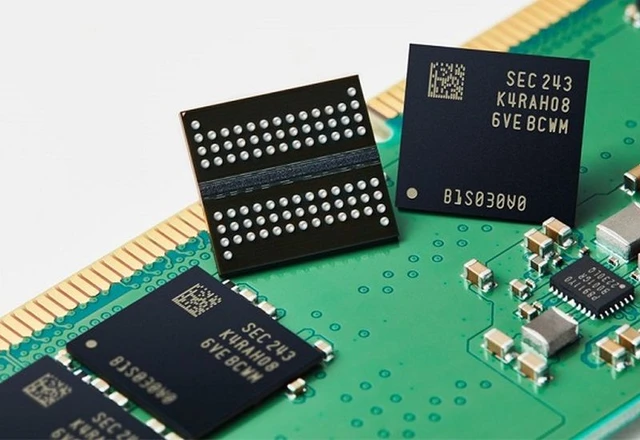
Regarding memory, the device relies on a proven stack: 8 GB of GDDR6 VRAM with an effective data transfer rate of 18 Gbps. The 128-bit bus provides a bandwidth of 288 GB/s, representing the sweet spot for 1080p resolution. Collectively, these specifications transform the Radeon RX 9050 Gaming OC into a balanced solution where the GPU's raw potential is fully realized through sophisticated engineering and thermal design.
 Forecasting Exponential Growth in Nvidia Shipments