In an era defined by rapid hardware turnover, platform longevity has become a rare and prized commodity. AMD’s AM4 socket has evolved into a gold standard for reliability and accessibility, maintaining its relevance long after its initial debut. The surprise rollout of new B450-based motherboards signals a return to the philosophy of pragmatic upgrades—optimizing system performance without unnecessary expenditure. Gigabyte is doubling down on these time-tested foundations, augmenting them with contemporary standards for connectivity and user experience.
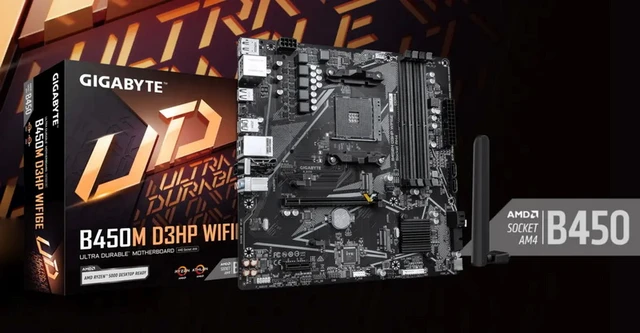
The arrival of new B450-based hardware years after its debut might seem like a technological anachronism, but it is rooted in deep pragmatism. While the industry pushes toward DDR5 and PCIe 5.0, a vast segment of users still relies on the stability and cost-efficiency of the AM4 platform. The release of the B450M D3HP and B450M D3HP WIFI6E is not merely a refresh of old revisions; it is a strategic offering for those seeking an optimal balance between budget and performance.
The technical architecture of both boards is based on the Micro-ATX form factor, making them ideal for compact builds. Stability is ensured by a 6+2 phase VRM, which provides sufficient power delivery for the reliable operation of most CPUs across the Ryzen 3000, 4000, and 5000 series. Four DIMM slots allow for flexible DDR4 memory scaling, providing the necessary bandwidth for everyday productivity and moderate gaming.
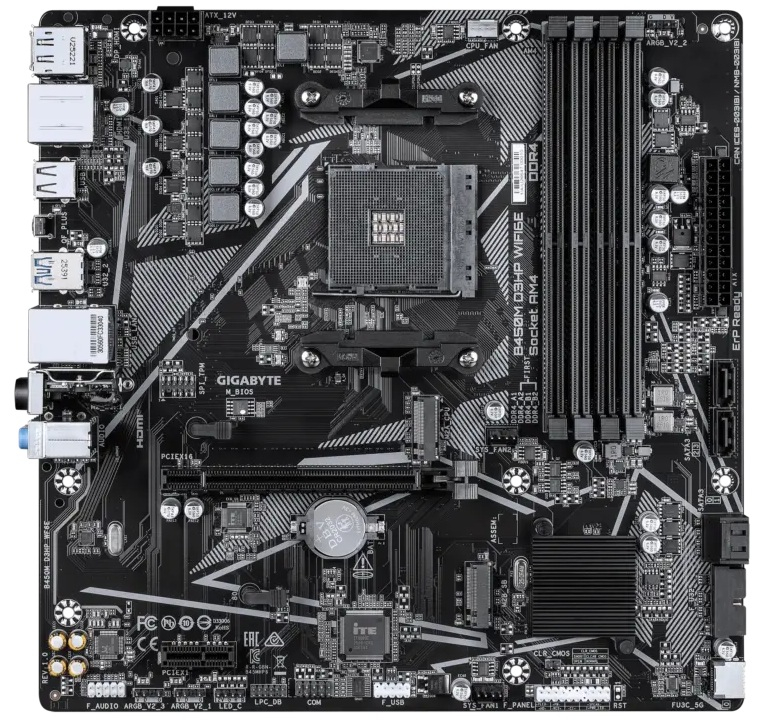
The storage configuration deserves particular attention. The boards feature two M.2 slots operating in different modes, highlighting the inherent hierarchy of the legacy chipset. The primary slot is linked directly to the CPU and supports PCIe 3.0 x4, ensuring maximum throughput for the system drive. The second slot utilizes B450 chipset lanes and operates in PCIe 2.0 x2 mode, making it better suited for secondary archives or less demanding SSDs. This setup is complemented by four traditional SATA III ports.
Despite its conservative foundation, Gigabyte has successfully integrated elements of a modern user experience into these models. A standout feature is Q-Flash Plus, which allows BIOS updates without requiring a CPU or RAM—an indispensable tool when deploying systems with newer Ryzen iterations. The front panel now includes a contemporary 5 Gbps USB-C port, while thermal management is handled via the intelligent Smart Fan 6 system. Visual aesthetics are addressed through three ARGB headers, allowing these boards to integrate seamlessly into modern customized builds with synchronized lighting.
In terms of I/O connectivity, the boards are equipped with DisplayPort 1.2 and two HDMI 2.0b ports, ensuring full compatibility with AMD's integrated graphics. Standard networking is handled by a proven Realtek Gigabit controller. However, the B450M D3HP WIFI6E elevates the platform's capabilities by introducing Wi-Fi 6E support. Operating in the 6 GHz band with data rates up to 2.4 Gbps, it transforms this "legacy" board into a modern communication hub, eliminating the primary drawback of older chipsets: limited wireless interfaces.
This approach to product line expansion demonstrates that the lifespan of high-quality hardware can be significantly longer than manufacturer marketing cycles suggest. Gigabyte is providing a viable tool for building affordable yet functional workstations where time-tested architecture meets modern standards of convenience.
 The Price of Acceleration: CXMT’s Rapid Push into Memory