The vision of a universal living-room gaming console has evolved, shifting from the confines of closed corporate ecosystems toward a landscape of open experimentation. Valve’s decision to broaden SteamOS support across diverse AMD and Intel platforms has catalyzed a new wave of Small Form Factor (SFF) DIY builds. This trend is blurring the line between the rigid constraints of traditional consoles and the versatility of desktop PCs. One such project vividly illustrates how additive manufacturing, paired with a strategic selection of components, can redefine the very concept of the Steam Machine.
The contemporary gaming landscape is shifting toward extreme miniaturization without sacrificing raw performance. When Valve announced that the latest iteration of SteamOS would become more hardware-agnostic, it served as a catalyst for enthusiasts worldwide. The prospect of engineering a device that mirrors a console in functionality and interface, yet possesses the horsepower of a full-fledged PC, has paved the way for unique hybrid systems.
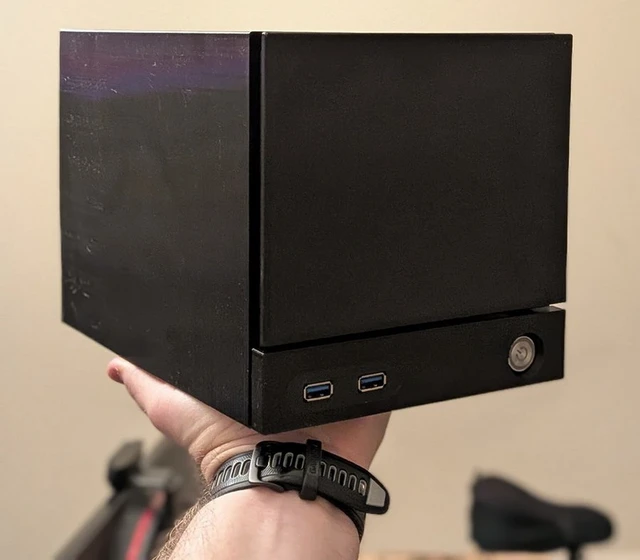
A standout example of this philosophy is the Terk Box v1.1. This bespoke project aims to create an ultra-compact computer that is virtually indistinguishable from the original Steam Machine in appearance, while housing an entirely different internal architecture. At its core lies a Mini-ITX motherboard, allowing for the most efficient utilization of the limited internal volume.
The defining departure from Valve's original design is the integration of a GeForce RTX 5060 GPU. While factory Steam Machines rely on semi-custom AMD GPUs based on the RDNA 3 architecture, this project demonstrates the versatility of the concept: a modern OS can operate effectively across different hardware vendors, provided the builder is willing to navigate certain technical trade-offs.
The chassis deserves particular attention. Rather than relying on industrial injection molding, the project leverages the capabilities of 3D printing. By utilizing the open-source SFF Mini ITX Steam Machine Case files from 3DCatt, the builder created an enclosure measuring 167 × 168 × 225 mm. The resulting system is slightly deeper than the original, a necessity dictated by the use of off-the-shelf components, which are significantly bulkier than the specialized chips found in mass-produced consoles.
A significant engineering hurdle arose during the selection of the power supply. The system utilizes a 400W Flex-ATX module. According to Nvidia's official specifications, an RTX 5060—with a power draw of 145W—typically recommends a 550W PSU. However, in the world of Small Form Factor (SFF) builds, manufacturer recommendations are often viewed as guidelines for the general consumer rather than rigid constraints.
For an experienced engineer, the discrepancy between 400 and 550 watts is bridged by an understanding of the system's actual power consumption. The combined TDP of the CPU and GPU in a compact chassis rarely hits peak values simultaneously. Furthermore, precise tuning of power limits and strategic undervolting allow the system to remain stable even on a lower-capacity power supply. This underscores a fundamental principle of modern modding: a deep understanding of electrical and thermal dynamics allows one to bypass marketing standards.
Nevertheless, the path of the custom build is fraught with economic challenges. With the original Steam Machine from Valve starting at $1,049, attempting to assemble an equivalent for under a thousand dollars using only new components is a daunting task.
This is where the "SFF tax" becomes apparent: Mini-ITX components and specialized Flex power supplies often command a premium over their full-sized counterparts, despite offering identical or even inferior specifications. When you add the cost of a high-quality cooling solution capable of managing heat in such a confined space, the budget escalates rapidly.
Ultimately, constructing such a device is justifiable only if one already owns some of the components or is adept at navigating the secondary market. The Terk Box v1.1 is more than just a technical experiment; it is a manifesto of personalization, where 3D printing and engineering precision transform a standard set of hardware into a unique piece of industrial design.
 The Phenomenon of the Foldable iPhone Ultra