The global automotive industry is undergoing one of the most profound tectonic shifts in its history. For decades, the market was defined by a rigid hierarchy dominated by Japanese, German, and American titans; today, that structure is rapidly dissolving. Recent data reveals that Chinese conglomerates have evolved beyond mere regional players, emerging as formidable contenders for global leadership. This transformation reflects not only China's economic ascent but also a fundamental pivot of the entire industry toward entirely new energy paradigms.
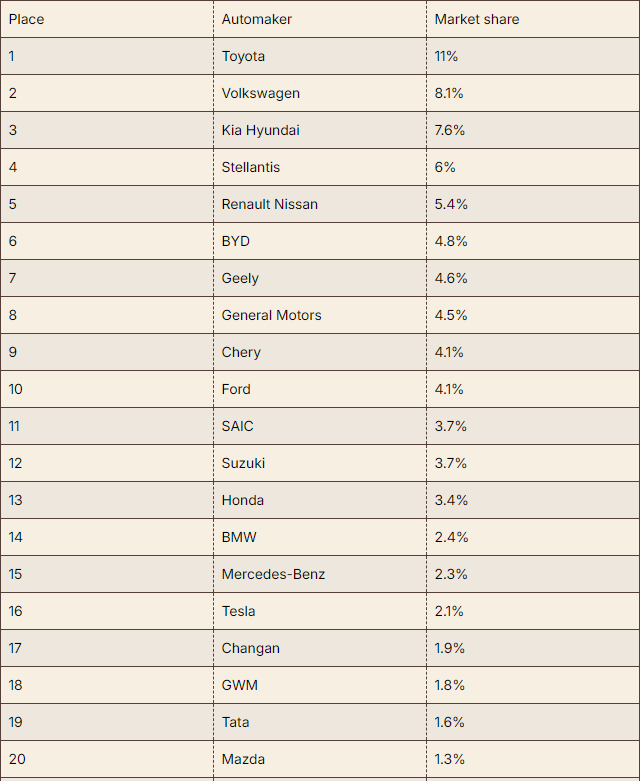
The global automotive landscape remains topped by traditional powerhouses, yet their dominance is no longer absolute. Toyota Motor maintains the lead with an 11% share of total passenger vehicle deliveries, followed by Volkswagen at 8.1%. The South Korean duo of Hyundai and Kia controls 7.6%, while the Stellantis conglomerate and the Renault-Nissan alliance hold fourth and fifth place with shares of 6% and 5%, respectively. Despite the stability of these positions, recent trends indicate a rapid closing of the gap between the old guard and emerging players from China.
The most striking shift is the ascent of Chinese manufacturers into the global top ten. Three PRC representatives—BYD, Geely, and Chery—have entered this elite circle, securing sixth, seventh, and ninth place. The progress of Geely and Chery is particularly impressive: a decade ago, their global market shares were a modest 1.5% and 0.8%; today, they have climbed to 4.6% and 4.1%. This growth was driven not only by domestic demand but also by an aggressive expansion strategy, including the acquisition of storied Western brands—most notably Volvo and Lotus in Geely's case.
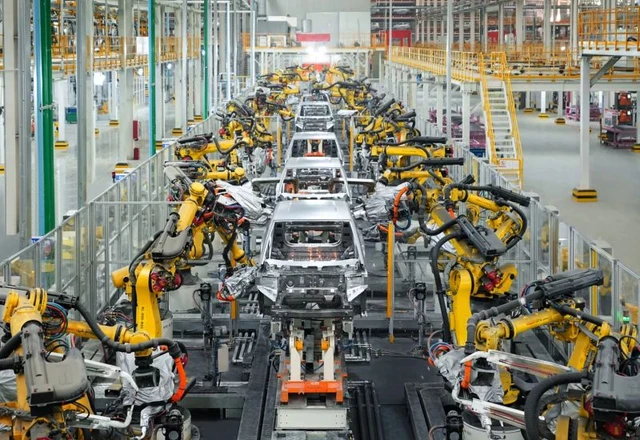
The BYD phenomenon warrants special attention. Ranking sixth globally with a 4.8% share, the company has become a blueprint for business transformation. Unlike many legacy manufacturers who attempted to integrate electric vehicles as mere supplements to their existing lineups, BYD fundamentally restructured its philosophy. By betting on the synergy between traction batteries and pure EVs, it has positioned itself as the primary catalyst of China's global offensive.
Simultaneously, the industry is witnessing a new wave of tech companies attempting to penetrate the automotive sector from the vantage point of IT giants. Xiaomi and Li Auto (Lixiang) currently sit at 29th and 30th place, with market shares under 0.4%. At first glance, these figures seem negligible compared to General Motors or Ford, who round out the top ten. However, there is a critical analytical nuance here: general statistics encompass all powertrain types, including traditional internal combustion engines (ICE). In the narrow segment of electric vehicles, the positions of Xiaomi and similar startups are far more formidable, creating a certain cognitive dissonance when comparing different rankings.
The overall distribution of power reveals that the Chinese automotive industry is implementing a multi-tiered expansion strategy. While flagships like BYD and Geely battle Toyota and Volkswagen for global leadership, a second wave—SAIC, Changan, GWM, and BAIC—is methodically consolidating its hold on the mid-market, creating a dense layer of competition. This shift signals that the era of Western and Japanese monopolies is definitively ending, giving way to a new age of technological parity and a fierce struggle for energy system efficiency.
 The Technological Leap of China's Consumer Market